
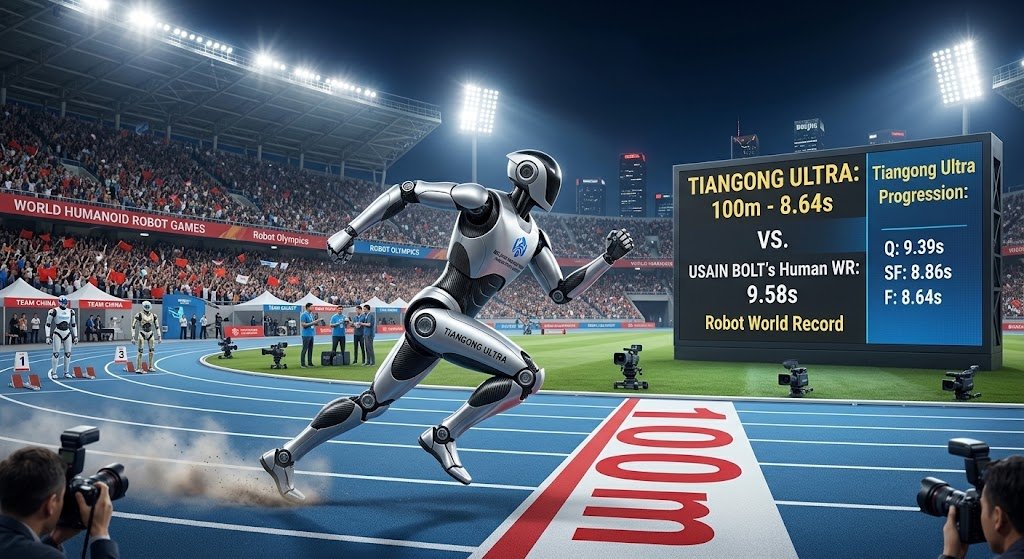
BEIJING: A Chinese humanoid robot has completed the 100 metres in 8.64 seconds, recording a time almost one second faster than Jamaican sprint legend Usain Bolt’s human world record.
Tiangong Ultra, developed by the Beijing Humanoid Robot Innovation Centre, won the large-size robot 100-metre final on Wednesday as the five-day World Humanoid Robot Games came to a close in Beijing.
The robot showed significant improvement throughout the competition. It clocked 9.39 seconds in qualifying before lowering its time to 8.86 seconds and then producing its winning 8.64-second performance in the final.
Bolt’s human 100m world record stands at 9.58 seconds, set at the 2009 World Championships in Berlin.
Robotics Takes Centre Stage
The 100-metre race emerged as one of the biggest attractions of the event, highlighting advances in robotic balance, movement and control technology.
Dubbed the “Robot Olympics,” the competition brought together more than 2,000 robots representing 666 teams, with the majority of participants coming from China.
The event featured 51 disciplines, combining conventional sporting contests with practical challenges designed to simulate environments such as factories, restaurants, offices and emergency situations.
Spectators said the robots appeared considerably more capable than those showcased during the inaugural competition.
“Last year’s robots looked a little stiff and uncoordinated,” said 34-year-old spectator Niu. “This year, they are much better. They are like healthy newborn babies growing up.”
Another spectator, 29-year-old Yang, said she could see humanoid robots eventually becoming a normal part of everyday life.
She suggested that people could one day have separate robots at home and at work, with the machines helping with household chores and caring for older people.
Testing the Future of Embodied AI
For robotics developers, the competition was more than a sporting spectacle. It provided an opportunity to test embodied artificial intelligence, a field that combines AI software with machines capable of sensing and interacting with the physical world.
He Wang, founder and chief technology officer of Galbot, said the event could help development teams improve their systems while demonstrating the capabilities of autonomous embodied AI.
The rapid improvement shown by Tiangong Ultra during the competition illustrates how quickly humanoid robotics is evolving.
While the robot’s 8.64-second performance cannot be compared directly with official human athletics records under the same sporting rules and conditions, its performance nevertheless offered a striking demonstration of advances in robotic locomotion.
Developers increasingly see such competitions as testing grounds for technologies that could eventually move beyond sporting demonstrations and into homes, workplaces, factories and care environments.