
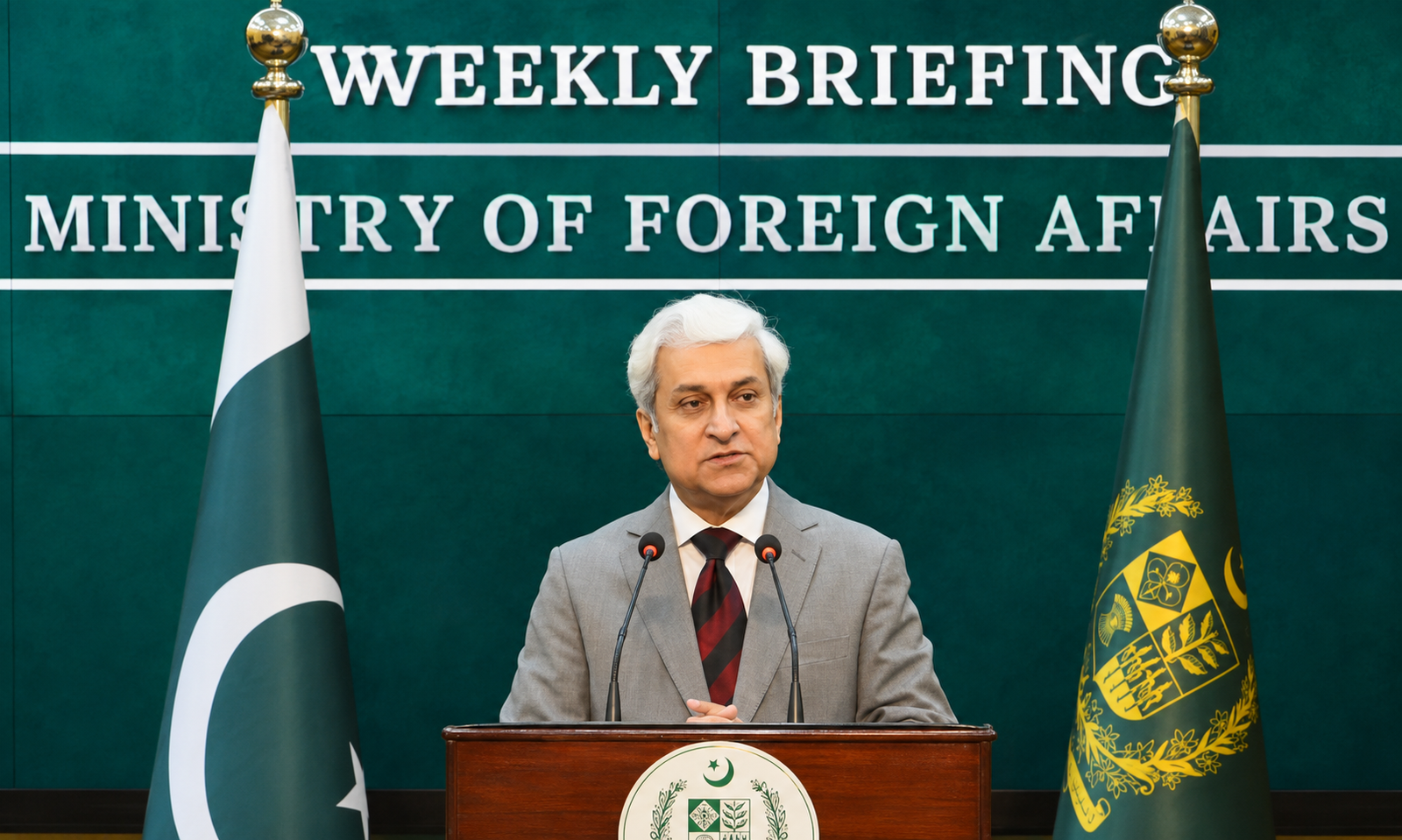
ISLAMABAD: Pakistan remains hopeful that diplomatic efforts can help end the ongoing conflict between the United States and Iran despite renewed tensions, Foreign Office spokesperson Tahir Andrabi said on Wednesday.
Speaking during a weekly media briefing, Andrabi said Islamabad would continue to support dialogue, restraint and diplomacy as the preferred means of resolving the conflict and restoring peace and stability in the region.
Pakistan has been actively pursuing diplomatic initiatives aimed at ending the conflict, including facilitating the Islamabad Memorandum of Understanding (MoU) in June and helping broker a ceasefire between Washington and Tehran in April. While the ceasefire halted the most intense phase of fighting, sporadic hostilities, particularly in the vicinity of the Strait of Hormuz, have continued to complicate efforts toward a permanent settlement.
Shehbaz Sharif, Iranian president discuss regional crisis
Andrabi said Prime Minister Shehbaz Sharif recently met Iranian President Masoud Pezeshkian on the sidelines of the Shanghai Cooperation Organisation (SCO) summit.
During the meeting, the prime minister reiterated Pakistan’s position that peace could be achieved through restraint, dialogue and diplomacy. He also emphasized the Islamabad MoU as a potential framework for achieving long-term regional stability.
Deputy Prime Minister and Foreign Minister Ishaq Dar also held discussions with Iranian Foreign Minister Abbas Araghchi on the sidelines of the SCO summit.
The FO spokesperson further recalled earlier discussions between Pakistani and Iranian leadership in Istanbul during a meeting linked to the Makkah defence pact, where developments in the Middle East and Gulf region were also reviewed.
Asim Munir’s Tehran visit
Andrabi said Field Marshal Asim Munir, Chief of Army Staff and Chief of Defence Forces, had also travelled to Tehran the previous week as part of Islamabad’s diplomatic engagement aimed at reducing tensions between Washington and Tehran.
A key focus of the discussions was the situation around the Strait of Hormuz, one of the world’s most important routes for energy supplies.
According to Andrabi, the talks focused on regional de-escalation, breaking the military deadlock and exploring possibilities for a negotiated settlement that could restore peace and stability.
He said the visit demonstrated Pakistan’s “sincere and constructive role” in helping bridge differences between the United States and Iran.
The diplomatic engagement subsequently gained momentum, with the leadership of Oman and Qatar also visiting Iran, he added.
Pakistan welcomes PCA ruling on Indus Waters Treaty
The Foreign Office also welcomed a recent ruling by the Permanent Court of Arbitration (PCA) concerning the Indus Waters Treaty (IWT) between Pakistan and India.
Andrabi said the court had reaffirmed that the treaty remained in force and legally binding, rejecting India’s unilateral attempt to place the agreement in abeyance.
He described the unanimous decision as an important reaffirmation of the treaty’s sanctity and the principle of international law.
The Indus Waters Treaty has remained a major point of contention between Islamabad and New Delhi since India announced its decision to place the agreement in abeyance in April 2025. The development was followed by a brief military confrontation between the two countries in May 2025.
Pakistan had strongly rejected any unilateral suspension of the treaty, arguing that it contained no provision allowing either side to suspend it independently. Islamabad also maintained that such action was inconsistent with the 1969 Vienna Convention on the Law of Treaties.
The PCA, in its ruling, supported Pakistan’s position that the treaty remained operational and that India had no legal basis to unilaterally terminate or suspend its application.
Andrabi said the court had also confirmed that India’s purported decision to place the treaty in abeyance did not remove its obligations under the agreement and that the treaty’s dispute-resolution mechanism remained applicable.
The court’s interim measure concerning the Ratle Hydroelectric Power Project further reinforced the principle that rights and obligations established under the IWT could not be changed through unilateral action, he added.
“Pakistan welcomes this clear and authoritative announcement,” Andrabi said, reiterating Islamabad’s position that disputes relating to the Indus Waters Treaty must be resolved strictly under the treaty and in accordance with international law.
New FO spokesperson introduced
At the conclusion of the briefing, Andrabi introduced Ambassador Sajjad Haider Khan, who is set to take over as Foreign Office spokesperson following the briefing.
For NewsWireWorld.com, the developments underline Pakistan’s continued emphasis on diplomatic engagement, regional de-escalation and international legal mechanisms in addressing major security and bilateral disputes.