
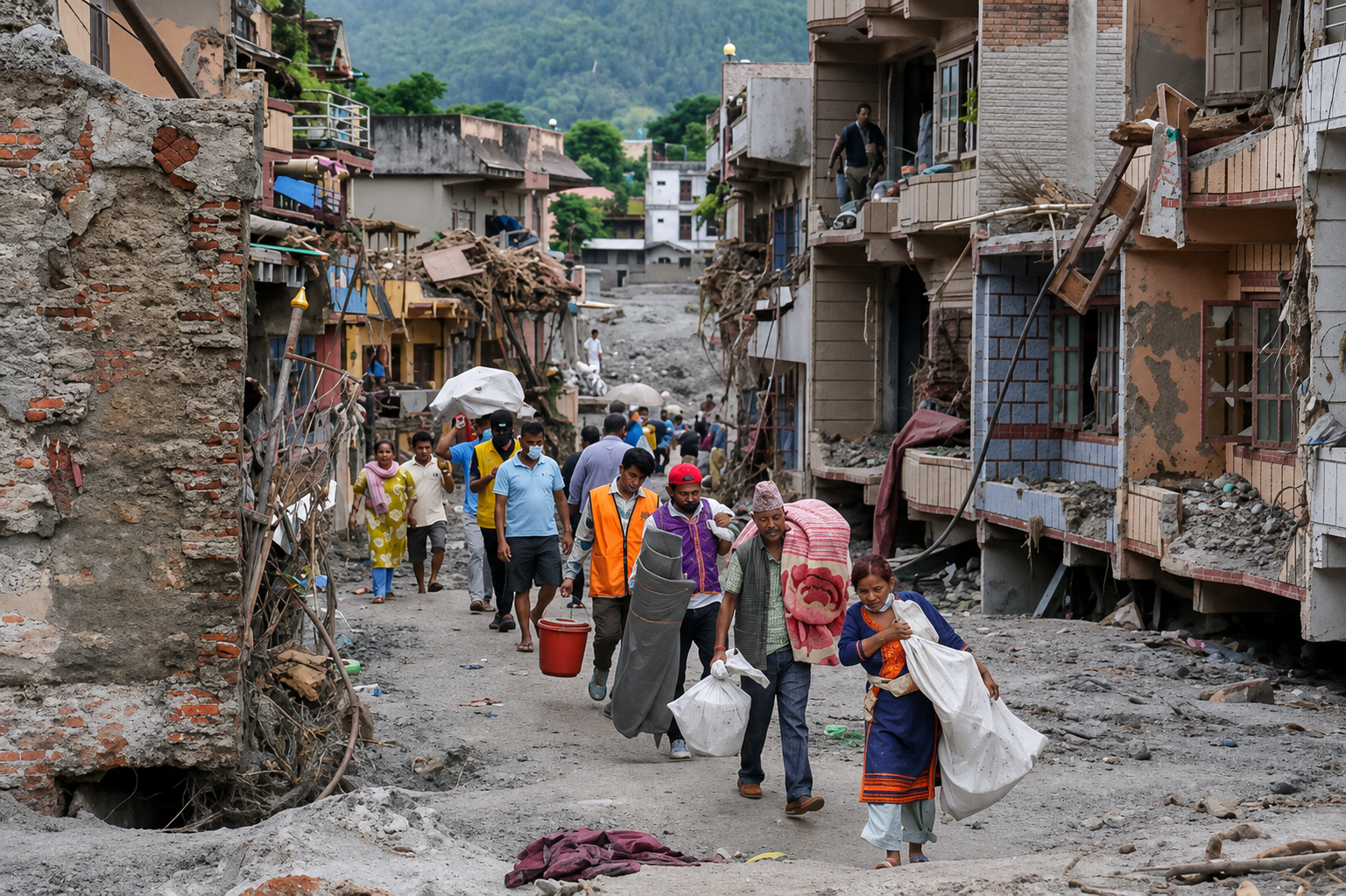
KATHMANDU: Rescue teams in Nepal and China’s Tibet region continued a desperate search on Saturday for thousands of people still missing after a massive flood of water, ice and debris swept through Himalayan communities, destroying settlements and leaving hundreds dead.
Authorities in Nepal and Tibet have reported nearly 3,000 people missing, while at least 633 bodies have been recovered. Some victims are believed to have been carried downstream into India, where authorities have recovered seven bodies from rivers flowing from Nepal.
The disaster struck on Wednesday near the Tibet-Nepal border after what the US Geological Survey identified as a glacial collapse, triggering a powerful torrent of water and debris downstream.
Rescue Teams Face Thick Mud and Severe Destruction
Rescue operations have been hampered by deep mud, destroyed infrastructure and difficult terrain.
Kawan Koirala, a member of Nepal’s Scout Disaster Response Team, said rescuers were struggling to search through mud that made movement extremely difficult.
After working an 18-hour shift, Koirala described the operation as deeply traumatic, saying families were desperately waiting to recover their loved ones while rescuers struggled to locate them.
Entire settlements along rivers were swept away, leaving survivors with little or nothing.
At an army base in Bidur, relatives gathered around lists of people who had been rescued, hoping to find the names of missing family members.
Many families said they had received no information about relatives who disappeared in the disaster.
Hundreds of Hydropower Workers Among Missing
The disaster has severely affected Nepal’s hydropower sector, where major infrastructure projects are located along river valleys.
Nepal’s disaster authorities said 933 hydropower workers were among those reported missing. The missing also include 517 foreign nationals, including trekkers and pilgrims travelling toward Tibet’s sacred Mount Kailash.
The Trishuli valley has been particularly badly affected, with several hydropower sites hit by the sudden flood.
More Than 100 Trapped Inside Hydropower Tunnel
Nepalese soldiers were working on Saturday to reach more than 100 people believed to be trapped inside a tunnel at the Trishuli 3A hydropower project.
Rescue teams began clearing mud and debris blocking the tunnel entrance, while a specialised Indian tunnel rescue team arrived to assist with the operation.
Nepal’s army said around 350 workers and residents had already been brought to safety from the site.
However, rescuers faced major difficulties because flood debris had made it difficult even to identify the tunnel’s original entry points.
Lake Burst Threat Declines in Tibet
Meanwhile, Chinese authorities said the immediate danger from a lake created by the glacier collapse appeared to be decreasing.
Satellite images taken between Thursday and Saturday showed that water from the lake had gradually flowed out, reducing the size of the reservoir.
Chinese state broadcaster CCTV reported that parts of the lakebed had become visible by Saturday afternoon.
The lake on the Purepu Tsangpo River covered approximately 99,000 square metres, according to China’s Water Resources Ministry. It had reportedly shrunk by around 21,000 square metres since Thursday.
The development reduced concerns about another major flood from the temporary lake, although authorities continued to monitor the area.
Death Toll Expected to Rise
The Red Cross said the disaster had caused enormous trauma and could have affected as many as 93,000 people.
Communities across the affected areas have been left short of essential supplies, including food and clean water, while fears of additional flooding have complicated rescue operations.
Nepal reported 626 deaths on Saturday, with 2,426 people still out of contact, including hundreds of foreign nationals.
In Tibet, Chinese state news agency Xinhua reported seven deaths and 554 people missing. Authorities said they had also evacuated 555 stranded tourists and 499 Chinese residents.
Climate Change Raises Concerns Over Glacial Disasters
The precise circumstances surrounding the glacier collapse remain under investigation. However, scientists have repeatedly warned that rising global temperatures are accelerating glacier melt and increasing the risk of glacial-related floods in vulnerable mountain regions.
The latest disaster has renewed concerns about the safety of communities and major infrastructure projects located downstream from glaciers and unstable mountain lakes.
Pilgrims Among Those Missing
The disaster also affected large numbers of Hindu pilgrims travelling toward Mount Kailash in Tibet.
Sivaranjani Muthunathan, who was travelling with a group of 56 people toward the Chinese border, described how what initially appeared to be a traffic delay suddenly turned into a life-threatening disaster.
She said fog, smoke and a rapidly advancing torrent suddenly surrounded the vehicles. People escaped by climbing out and scrambling toward higher ground as vehicles were swept away or buried under mud.
With thousands still unaccounted for, rescue teams in Nepal and Tibet face a race against time to locate survivors and recover those who remain missing.