
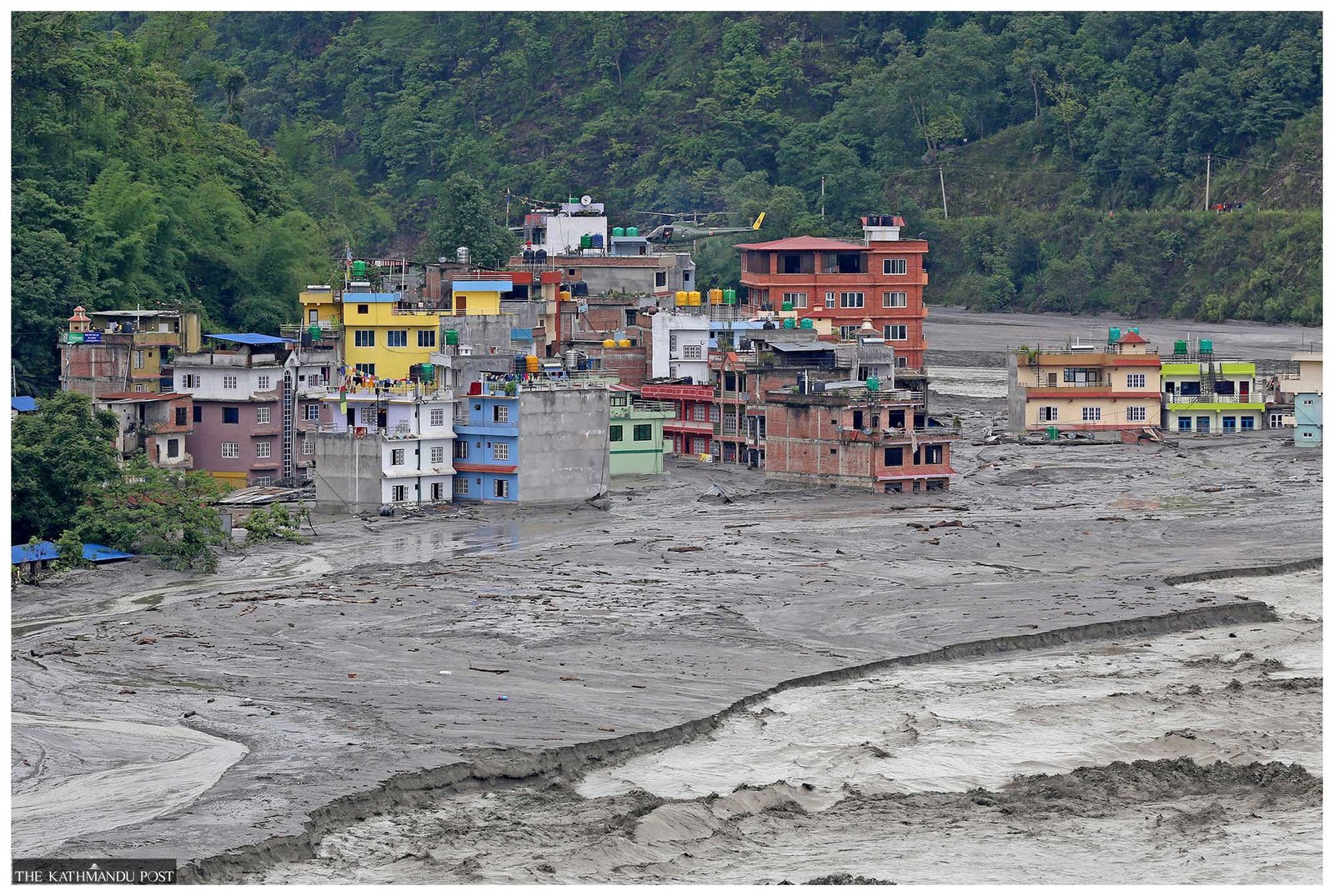
KATHMANDU: At least 95 people have been killed and hundreds remain missing after a devastating flash flood swept through Nepal’s Himalayan border region with Tibet on Wednesday, destroying homes, roads, bridges and hydropower infrastructure.
The disaster struck after a huge mass of mud and rock entered the Lhende Khola river, sending a destructive surge downstream through parts of Nepal’s Rasuwa district. Police confirmed the death toll had reached 95, while numerous people remained unaccounted for.
The scale of the disaster continued to emerge as rescue teams searched affected communities. Hundreds of travellers were also reported missing, including foreign nationals from several countries.
Earthquake and Ice-Rock Avalanche Suspected
The exact cause of the disaster remains under investigation, but preliminary assessments suggest that an ice-rock avalanche may have blocked the Lhende River, triggering a sudden release of water and debris.
The German Research Centre for Geosciences reported that a magnitude 4.4 earthquake occurred in the region shortly before the flooding, raising the possibility that the tremor contributed to the avalanche. Experts have stressed that the precise chain of events has yet to be conclusively established.
Satellite imagery showed extensive destruction along the river corridor, with settlements and infrastructure affected well beyond the original river channel.
Hundreds of Travellers Missing
Nepalese authorities reported hundreds of people missing in the disaster zone, including foreign tourists and travellers.
The missing included more than 100 Indian nationals, three U.S. citizens and 12 British nationals, according to reports available Wednesday. South Korea also said eight of its nationals working at a hydropower project in the affected area were missing.
The number of missing people remains subject to revision as authorities continue to restore communications and compile lists from different affected locations.
Villages and Infrastructure Swept Away
The flood devastated settlements along the Bhote Koshi River, which receives water from the Lhende Khola.
Homes, vehicles, roads, bridges and power projects were swept away by the torrent. Officials urged residents living along riverbanks to move to higher ground as water levels remained dangerously elevated.
Rescue operations have been complicated by damaged roads, disrupted communications, continuing rainfall and difficult mountainous terrain. Helicopters have also faced problems landing in some of the worst-hit areas.
Nepalese authorities have appealed for assistance from neighbouring India and China as search and rescue operations continue.
China Reports Damage in Tibet
On the Chinese side of the border, a mudslide struck the Gyirong area, damaging roads and cutting communications and power connections.
Chinese authorities deployed hundreds of personnel, vehicles, rescue equipment and search dogs to the affected area. Officials warned that continuing rainfall could further complicate rescue efforts and increase water levels.
Chinese President Xi Jinping called for intensified search and rescue operations and stronger monitoring and early-warning measures to reduce the risk of further disasters.
Authorities Warn of Possible Second Flood
Experts have warned that the danger may not yet be over.
A blockage reportedly remains upstream on the Lhende Khola, raising concerns that additional water could accumulate and trigger another flood if the obstruction suddenly fails.
Authorities in northern India have also issued flood alerts in Uttar Pradesh and Bihar, where rivers originating in the Himalayan region flow southward. Bihar officials said thousands of residents were being evacuated from vulnerable districts as a precaution.
The disaster is the latest in a series of severe flooding events affecting the Himalayan region, highlighting the growing risks faced by communities living near glacial, mountainous and river systems.
Rescue teams in Nepal, China and other affected areas are continuing search operations, while authorities work to determine the full extent of the casualties and destruction.