
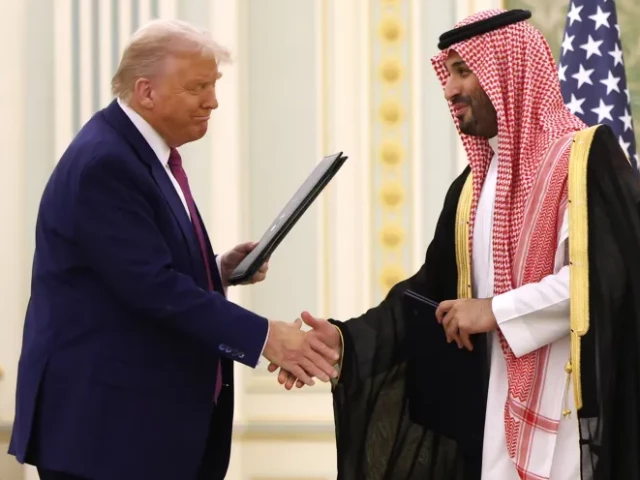
WASHINGTON: US President Donald Trump has sent a proposed civil nuclear energy agreement with Saudi Arabia to Congress, while maintaining that the pact will only take effect if Riyadh agrees to normalise relations with Israel.
A US administration official told Reuters that the agreement, reached in July, was formally submitted to Congress on Monday. The proposed deal would allow American companies to export civilian nuclear technology to Saudi Arabia.
The official, who spoke on condition of anonymity, said Trump’s position remained unchanged: the nuclear agreement would move forward only if Saudi Arabia joins the Abraham Accords, the US-backed framework for establishing diplomatic relations between Israel and Arab and Muslim-majority countries.
The Saudi embassy in Washington did not immediately comment on the development.
Nuclear agreement faces congressional review
Under the proposed arrangement, Congress has 90 session days to review the agreement. Unless lawmakers formally object within that period, the pact is expected to take effect.
If Congress rejects the agreement, Trump could veto the decision. Lawmakers would then need a two-thirds majority to override the presidential veto.
The agreement was sent to congressional leaders and is expected to be referred to relevant committees for further consideration.
Israel recognition remains key condition
Trump has made Saudi-Israeli normalisation a central condition of the nuclear agreement. The position mirrors efforts during the administration of former President Joe Biden, who also sought to connect a US-Saudi nuclear cooperation deal with Riyadh establishing relations with Israel.
Talks toward Saudi-Israeli normalisation appeared to be progressing in 2023, but the outbreak of the Gaza war in October that year significantly altered the diplomatic environment.
Saudi Arabia has maintained that it would require an irreversible pathway toward the establishment of a Palestinian state before recognising Israel.
Billions of dollars in nuclear projects
The proposed agreement would remain in place for 30 years and includes plans for the construction of AP1000 nuclear reactors, a project potentially worth tens of billions of dollars.
The development could provide a major commercial opportunity for Westinghouse, which is jointly owned by Canada’s Cameco and Brookfield Asset Management.
Concerns over uranium enrichment
The agreement has also drawn criticism from some Democratic lawmakers and nuclear nonproliferation advocates because it does not appear to completely prohibit Saudi Arabia from enriching uranium or reprocessing spent nuclear fuel.
Both activities can have civilian applications but can also provide potential pathways toward developing nuclear weapons.
The United Arab Emirates accepted restrictions on enrichment and reprocessing in its 2009 nuclear cooperation agreement with Washington, provisions often described as the “gold standard” for nonproliferation safeguards.
The Trump administration, however, has argued that the Saudi agreement contains the nonproliferation measures required under US law.
Henry Sokolski, head of the Nonproliferation Policy Education Center, warned that congressional consideration could ultimately create an opportunity for the agreement to advance without all of Trump’s stated conditions on nuclear proliferation and diplomatic normalisation.
The congressional review is therefore expected to determine not only the future of US-Saudi nuclear cooperation but also whether Washington can use the agreement as leverage to advance Saudi-Israeli normalisation and broader regional diplomacy.